
During a distinguished academic career as Professor of English at Exeter University, Moelwyn Merchant began to make sculptures in 1964 under the influence and tutelage of his friend Barbara Hepworth who he first met in 1951. Their refined intellectual and artistic kinship flourished until Hepworth's tragic death in 1975.
Moelwyn Merchant's friendship with Hepworth deepened during the 1960s when Merchant was able to make frequent trips to St. Ives from Exeter. In his published memoir, Fragments of a Life, he recounted the revelatory impact of the numerous visits to Hepworth's St. Ives studio:
Contact with Barbara Hepworth meant, however, an initiation into a pattern of discipline different from that of the painter. For the sculptor is to a substantial degree indebted to the skills of the studio assistants who undertake much of the arduous work in the early and middle stages, as a piece of sculpture presses towards realisation. I learnt a great deal from contact in those days with her 'boys' as she called her mature and highly competent assistants.
For some months I had delighted in the new insights in St. Ives, in the studio of an artist who had lived and fought through the struggles which this century had seen, to establish a valid sculptural tradition in this country. With Gabo and Ben Nicholson and a handful of others, Barbara Hepworth had inherited and enlarged the scope and modes of the sculptural tradition from Rodin and Brancusi and which burst into its first and perhaps fullest creative life in this country in her work and in Henry Moore's.
All this was vibrant about me in the studio at St. Ives, in the stoneyard with its partially prepared blocks of marble and in the splendid maze of the garden, where one passed from sculpture to sculpture and then, returning to the studio, saw work in progress, creation in toughest stages.
One of these visits was to see how she was progressing after a fracture of her hip, which our friend, Norman Capener, consultant orthopaedic surgeon at Exeter, had set for her. (He was the subject of her splendid series of drawings in the operating theatre, drawings which were remarkably sculpturesque in their masked and robed anonymity). The administration of the department at Exeter, the work of Chancellor in the Cathedral at Salisbury and my regular visits to the University of Chicago had sapped my energies and after a pause in our mutual concerns, Barbara said sharply: 'You live too much from here to here', moving her forefinger across the width of her forehead; 'You're all thought! Let's see if you have a pair of hands.'
She trundled her wheel-chair across the studio and began moving about her sculpting tools. I was interested especially in one set of gestures: she picked up a substantial sculptor's hammer, looked across at me as she hefted it in her small hand, slightly shook her head (clearly I could not be expected to handle a tool as heavy as her customary working instrument!) and came back to my chair with a large set of sculpting tools - mallet, hammer, chisels, claws, rifflers - and placed them before me. Some of them were marked with the red adhesive tape which distinguished her tools from those of her 'boys' and these are still treasured. Without explaining their use she left them and went across to the telephone, called Delabole Slate Quarry and asked them to put some of their best slate ("the quality you give me") into the boot of my car as I passed on my return to Exeter.
"Now I want a piece of sculpture in a month's time." Dame Barbara was not one to be argued with lightly. For some three years I went back again and again to St Ives, for the finest teaching imaginable. After one visit to Scotland, to the bay of Portsoy on the Banffshire coast, I brought back to Exeter several pieces of the local serpentine ('Portsoy marble') and carved my first 'male torso'. I took it down for her comment and it was placed between us on her glass-topped table. She prodded and rotated it to see it in the round:
"Yes; that'll do. But I think that the top curve should be lowered by about an eighth of an inch."
It was the most treasured accolade I had ever received!
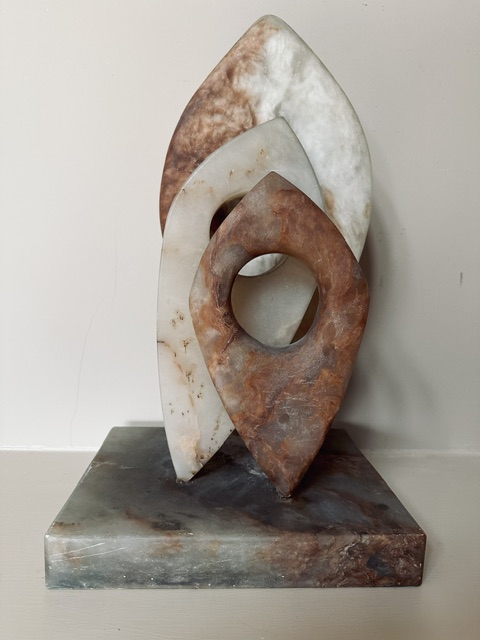 Moewlyn Merchant - 'Pierced Oval Forms' - alabaster
Merchant soon followed his own path in sculpture exploring themes of myth, religion and organic growth - an obsession with open and closed forms were all metaphors for his own spiritual journey. Working in a wide variety of materials including bronze, slate, stone, wood and glass he quickly developed his aesthetic identity whilst continuing to seek out Hepworth's guidance:
Barbara Hepworth's influence on my work extended long after our friendship was broken by her death. I had shown her one of my earliest versions of 'Growing Form" some ten inches high. The next day, 18 June 1973, she wrote to me:
'Thank you for showing me the new work. I really do think that you would get a great kick out of developing this piece to six or seven feet. It need not cost much, but it would give you such a joy to see the way these forms would develop.
I look forward to hearing that you have acquired a place in which to do it, and I hope that we can meet again before long.'
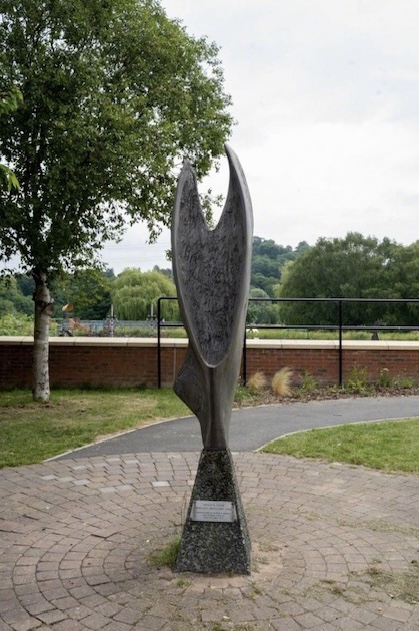
Over the next ten years 'Growing Form' amply lived up to its name. I made two more bronze versions about fifteen inches high, an aluminium cast about twenty-four inches high, now in the Whitworth Art Gallery in Manchester, and, making a considerable leap upwards, when the Burton-on-Trent Art Committee were able to commission a large piece of sculpture for the bank of the Trent outside their library, with a grant from the Arts Council; 'Growing Form' in seven hundred pounds of cast aluminium on a concrete plinth, stood over nine feet tall.
 .
.
Moelwyn Merchant - 'Growing Form'
A new departure for me was to work with a sheet-steel craftsman, Eddie Carter of Spa Sheet Metal. With an armature of steel rods clad with sheets of steel, the form now grew with a new lightness and grace. It was once more over ten feet in height and when I had devised an almost bark-like finish with 'sculpted' Isopon, it grew with a new propriety out of the ling and the heather of the Scottish Sculpture Park at Carrbridge in Inverness-shire and surrounded by pines of the ancient Caledonian Forest.
These all owe their existence to those years of unobtrusive learning, in conversation with Barbara Hepworth and the asides she dropped into talk in the studio or in subsequent letters, asides which always contained the seeds of new forms to pursue. I wish she could have seen 'Growing Form' in its Scottish setting.
Merchant exhibited widely throughout Britain, including major shows at the Exeter Museum and Art Gallery, Museum of Wales, Eton College and the Ben Uri Gallery in London. Writing about his aims he declared: 'There have been great compensations: already over the years I had developed a respect for and fear of the fragility of man's life; the sense of growth in natural forms obsessed me; and, above all, I had been convinced as priest and critic, that man's finest attribute was his sense of awe, the sure knowledge that about us, within us and above us is a majesty and a compassion before which we bend... man's delicate poise, the glory of natural growth, and awe before the mysterious and the divine.'
In 1982 Merchant was asked to write the introdcution to the Marlborough gallery's important exhibition of Barbara Hepworth's carvings. His understanding and intellectual affinity with Hepworth informed a poetic tribute to a person that had enriched and changed the course of his life:
Stillness, perfect equipoise, abstraction, are hard-won out of mental and emotional struggle, an 'abstract art' less akin to geometry than to the last quartets of Beethoven... For Barbara Hepworth's work is finally centred upon man, man in his personal integrity, in his human relationships and in the mystery of his landscape.
The day after Hepworth's death Merchant received a phone call from Sarah Bowness informing him that Barbara had left 'requests concerning her burial and and asked that I should officiate at the Committal at the graveside. It was a sad and proud office to perfom.'
Literature:
Merchant, Moelwyn, Fragments of a Life, Gomer Press, Dyfed, (1990)
Merchant, Moelwyn, Barbara Hepworth Carvings, Marlborough, London, (1982)
Brake, Steve (ed.), Moelwyn Merchant: A Life's Work, Clwyd County Council, (1985)
Note:
The William Moelwyn Merchant archive was presented to Eton College by him in 1988, in honour of his fondness and his increasingly close association with the school and College Library. He continued to add to the collection until his death in 1997, when the family added further papers.
https://collections.etoncollege.com/a-gathering-of-friends-the-festschrift-and-moelwyn-merchant/
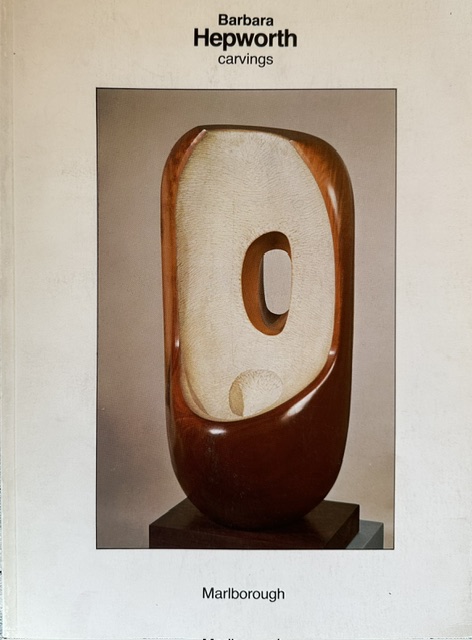 Introduction by Moelwyn Merchant (1982)

