Graham Sutherland
1903-1980
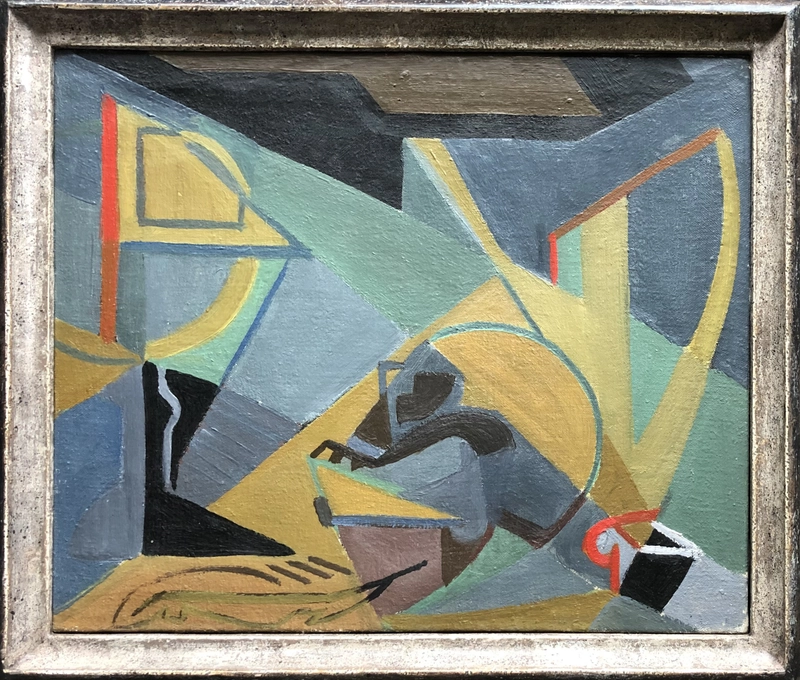
Sutherland began his career as an apprentice to the engineering department of the Midland Railway Works at Derby, but after a year he returned to London and became a student at the Goldsmiths' School of Art, 1921-26. There he concentrated upon engraving and by 1930 he had achieved a considerable reputation as an etcher of landscape. From 1927 he taught at the Chelsea School of Art. The boom in etchings came to an end at the close of the 1920s and c. 1932 Sutherland took up painting, developing almost from the first a highly individual style of landscape. The influence of Samuel Palmer, which had been strong in his etchings, was gradually overcome as his personal vision matured. Sutherland drew his inspiration not from the familiar but from the elements of strangeness in nature, finding his motifs in Pembrokeshire, the westerly part of Wales, and Cornwall. Renouncing perspective in favour of a 'non-scenic' vision of landscape, he turned his paintings into semi-abstract patterns of haunting and monstrous shapes. In 1940 he did costumes and décor for the ballet The Wanderer in an analogues style. By the end of the 1930s Sutherland had won considerable recognition both in his own country and on the Continent. Writing in 1943 Edward Sackville-West was expressing an accepted view when he linked Sutherland and Henry Moore as 'two of the most significant artists of our time'. From 1941 to 1944 Sutherland worked as an official War Artist and his paintings of bomb devastation, work in mines and foundries, continued his former technique. After the war he took a series of important portrait commissions, notably Somerset Maugham, Lord Beaverbrook and Winston Churchill. He was awarded the Order of Merit in 1960 and retrospective exhibitions were staged at the Venice Biennale and at the Musée National d'Art Moderne, Paris, in 1952, at the Tate Gallery in 1953 and at Amsterdam, Zurich and Boston.
Works Available
Contact gallery for details