John Piper
1903-1992
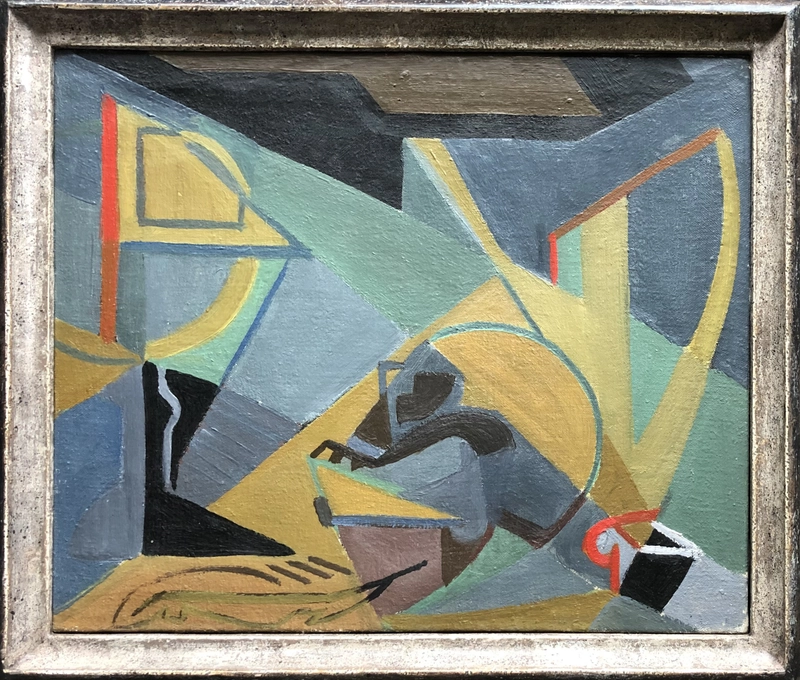
Born at Epsom, Surrey, Piper began his career articled to his father's law firm where he remained until 1926. He obtained his artistic training at Richmond School of Art under Raymond Coxon and then at the Royal College of Art, where Henry Moore was a teacher. From 1928 he wrote reviews for the Listener and the Nation. He showed himself to be a discerning critic, being among the first to recognize contemporaries such as Ivon Hitchens, William Coldstream, Ceri Richards and Victor Pasmore. In the early 1930s he became absorbed in the abstract movement of which Ben Nicholson and Barbara Hepworth were leaders, and was strengthened in this direction by a visit to Paris in 1933, when he met Braque, Brancusi, Léger and Hélion. He was also associated with the pioneer review of abstract art Axis edited by Myfanwy Evans, whom he married in 1935. His abstract paintings during this period, done in subdued greys, blues and black heightened with touches of red, were praised by Hugh Gordon Porteus for 'a beauty, a purity and an honesty which must compel admiration'. But he did not cease topographical drawing and painting, delighting particularly in coastal scenes and old chapels in their rural setting, continuing also his interest in stained glass tracings. During the latter part of the 1930s he more and more abandoned the abstract, reverting to representational landscape. John Betjeman says: 'From 1938 until the war he made regular tours to various parts of England and Wales, looking for stained glass, churches with box-pews in a Cotman state of picturesque decay, ruins, early industrial scenery, Welsh lakes and waterfalls, country houses, Yorkshire caves. He came back with hundreds of watercolours and material for later oils.' In 1972 he was made a Companion of Honour and in 1983 the Tate Gallery in London staged a major retrospective of his work.
Works Available
Contact gallery for details