Victor Pasmore
1908-1998
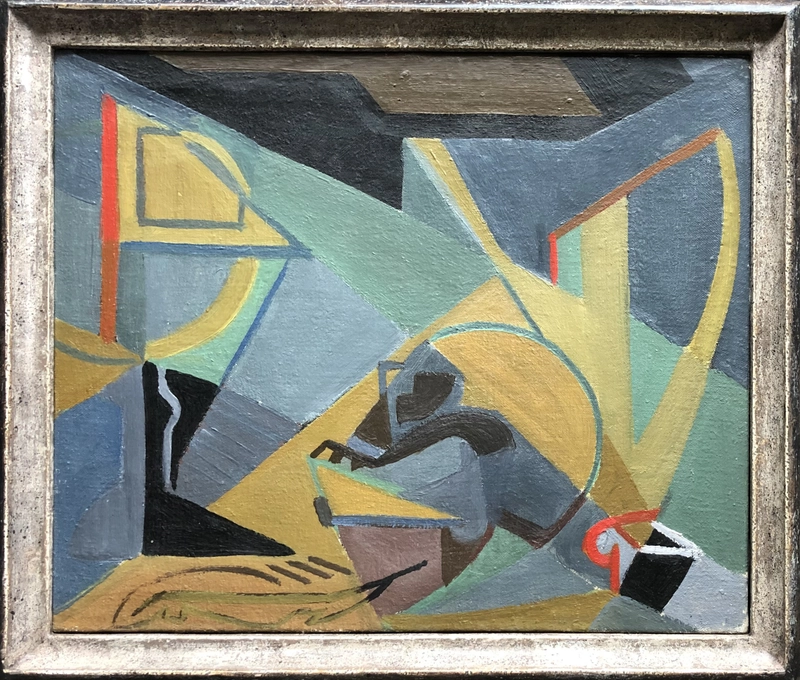
Educated at Harrow School, Pasmore subsequently took up a job in the Public Department at County Hall in London. However, he continued to paint and in the evenings he studied at the Central School of Arts and Crafts under A. S. Hartrick. His first solo exhibition was held at the London Artists' Association in 1933. It was through his membership of the Allied Artists' Association that he met Claude Rogers and William Coldstream. With them he founded the Euston Road School, which encouraged a return to realist painting. At this period Pasmore's oils and watercolours expressed a concern for an overall tonal unity. Sir Kenneth Clark's patronage in 1938 enabled him to become a full-time painter. After the war he began to experiment with abstraction and during the 1950s he was a key figure in the English Constructivist movement. In conversation with Andrew Lambirth, Pasmore remarked: 'Beauty is a paradox. Nature is a paradox. Really great art is paradoxical. It can transform ugliness into beauty. But beauty is its basis, not ugliness. Anybody who thinks he's being clever by painting an ugly picture can pack up.' In 1954 he was appointed master of painting in the Department of Fine Art, Durham University. From 1966 he lived and worked in Malta. The Tate Gallery staged a retrospective exhibition of his work in 1965 and the Arts Council arranged a major travelling show in 1980. He was awarded the C.B.E. in 1959.