Jean Marchand
1882-1941
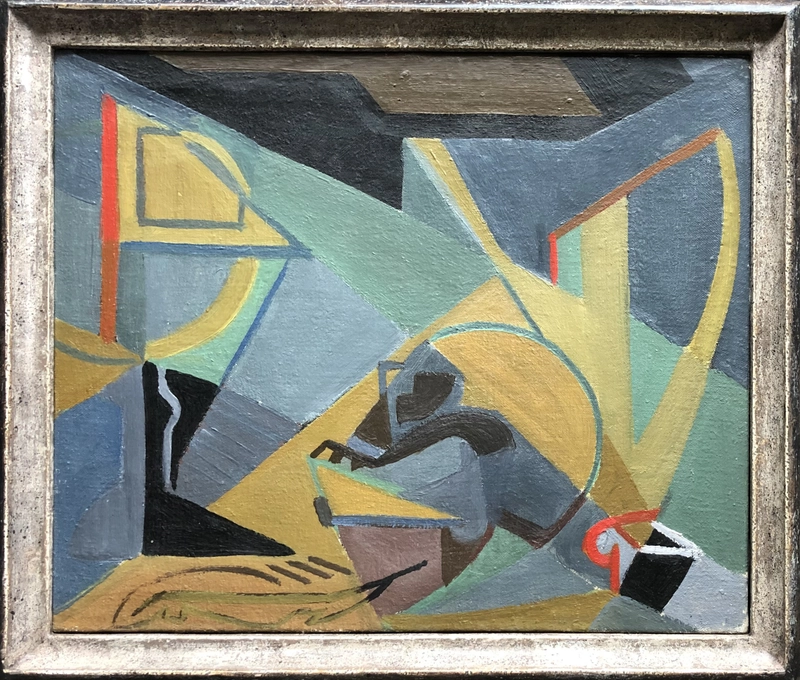
Born in Paris, Marchand trained part-time at the École des Beaux-Arts there, 1902-9. He exhibited at the Salon des Indépendants from 1908 and also at the Salons d'Automne and Tuileries. His first paintings were of landscapes and tramps sleeping out of doors. This work shows a reconciliation between the formal simplifications of Cézanne and the colour simplifications of Gauguin. There was also some affinity with the work of Braque and Dufy in their immediate post-fauvist period. In 1910 he also experimented with Cubism, but in the 1920s he developed a style of vigorous naturalism akin to that of Derain. When some of his work was shown in a collective exhibition at the Carfax Gallery, London, in 1915, Clive Bell wrote: 'No living painter is more purely concerned with the creation of form and the emotional significance of shapes and colours than Marchand.' His work had a huge influence on the aesthetic theories promoted by Clive Bell and Roger Fry.His first one-man show was at the Carfax Gallery in 1919, after which he exhibited frequently in Paris and internationally, including a large exhibition at the Gallery Georges Giroux, Brussels, in 1930. Among his murals was one for the Residence at Beirut done in 1928. He also did an important volume of graphic work including illustrations for Le Cimetiere marin by Paul Valéry and Chemin de Croix by Claudel. He had a posthumous exhibition at the Redfern Gallery, London, 1n 1955, followed by retrospectives in Paris, Basle, Milan, Rome, in 1956 and at the Gallery del Cavallino, Venice, in 1957. Paintings by Jean Marchand are in the Museum National d'Art Moderne, Paris, the Tate Gallery, the Courtauld Gallery, the Albertina, Vienna, the Museum du Luxembourg, the Walker Art Gallery, Liverpool, and also in New York, Chicago, Tokyo, Johannesburg and elsewhere.