J. D. Fergusson
1874-1961
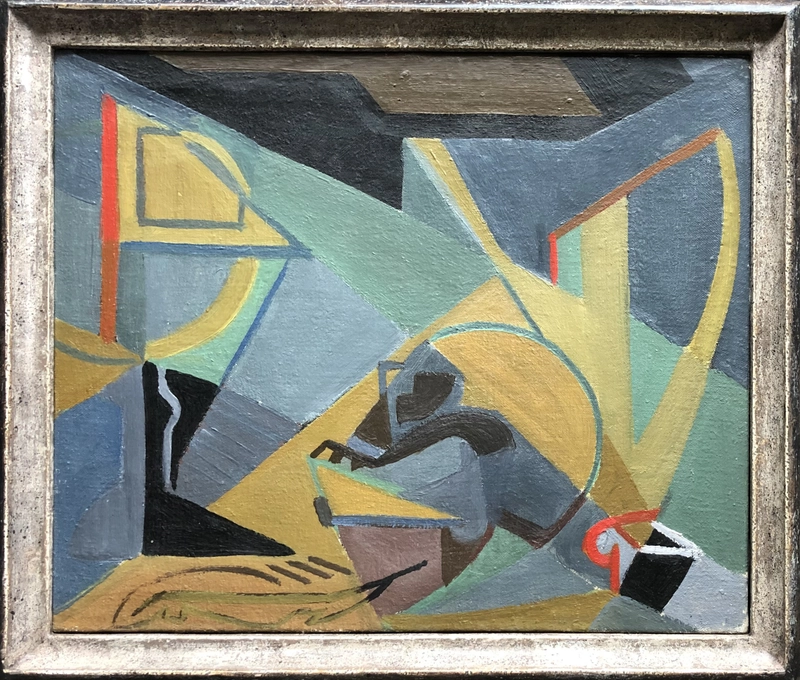
Born at Leith and educated in Edinburgh, Fergusson began by studying medicine and in 1894 decided to follow an artistic career. Apart from a brief period at the Académie Colarossi in the late 1890s, he had very little formal art training. From the mid 1890s he made frequent visits to Paris and finally settled there c. 1905-7. He exhibited at the Salon d'Automne 1907-12, and in London at the Royal Society of British Artists, 1899-1907, and the Allied Artists' Association, 1907-12. His first one-man exhibition was staged in London in 1905. Starting from Whistler and influenced by some of the Glasgow School, Fergusson's style of painting shows a logical development from the Impressionists to Toulouse-Lautrec and the Fauves. A change came over his work around 1910 when the nude for the first time became a dominant theme. He continued the Fauvist method of echoing the figure in the background, but his colours became less strident, his outlines more emphatic and a new formalization appeared. Except in the large nudes his work was distinguished from that of the Fauves by his more personal involvement with the subject. Deriving perhaps from his interest in ballet, the rhythms of his group figure paintings and drawings were now more vigorously emphasized. One picture entitled Rhythm (University of Stirling) was seen by Michael Sadleir and Middleton Murry at the Salon d'Automne and in consequence the word 'Rhythm' was taken as the title for a new magazine launched by Middleton Murry and Katherine Mansfield, of which Fergusson became art editor. In 1911 he was made a member of the Salon des Indépendants. The First World War brought him back to London where he joined the navy.
During the inter-war years he moved between London, Paris, Scotland and the south of France. His first Scottish exhibitions were at Edinburgh and Glasgow in 1923. He was exhibited in New York in 1926 and 1928. During the 1930s he became President of a Groupe des Artistes Anglo-Américains in Paris. With his old friends S. J. Peploe, Leslie Hunter and F. C. B. Cadell he formed a loosely associated group known as the Scottish Colourists and in 1940 he was President of the New Scottish Group of painters. His first retrospective exhibition opened in Glasgow in 1948. In 1961 a Memorial Exhibition was organized by a Scottish Committee of the Arts Council and a retrospective was staged at the Leicester Galleries in 1964. A centenary exhibition was arranged by the Fine Art Society in London, Glasgow and Edinburgh in 1974.